Argentina and Turkey: A Strategic Partnership Towards the Global Future
In a significant step for its foreign policy, Argentina formally expressed its interest in becoming a “global partner” of the North Atlantic Treaty Organization (NATO) one year ago. This request, submitted by Argentine Defense Minister Luis Petri in April 2024 at NATO headquarters in Brussels, reflects the country’s desire to “restore ties that allow us to modernize and train our forces to NATO standards.”
NATO was founded in 1949 after World War II as a collective defense bloc to counter Soviet influence at the onset of the Cold War. It currently consists of 32 member states from North America and Europe, including Turkey, which joined NATO in 1952 during its first wave of enlargement.
Since then, Turkey has played a crucial role due to its strategic location between Europe, Asia, and the Middle East. It has made significant contributions to securing NATO’s southeastern flank during the Cold War and continues to do so today through crisis management and peacekeeping missions.
Turkey’s importance is evident in the choice of Istanbul as a venue for peace talks between Russian and Ukrainian officials, in hosting recent meetings aimed at increasing funding from member states, and in being designated as the host of the upcoming 2026 NATO Summit.
Moreover, Turkey has the second-largest army in NATO, second only to the United States. This military capacity allows it to play a central role in rapid deployment operations, crisis management, and regional cooperation. Its influence is further bolstered by the steady growth of its defense industry, making it a key partner for countries seeking to strengthen their ties with the Alliance and enhance cooperation in defense, technological innovation, and industrial development.
For its part, Argentina was designated a “Major non-NATO ally” in October 1997—a status created by the U.S. Congress in 1989—which has enabled it to receive economic benefits (such as access to financing) and military advantages (such as arms procurement and participation in military exercises, among others). In this context, strengthening bilateral relations with Turkey, a key NATO member, acquires particular strategic importance.
However, it is essential to understand that the strategic importance of promoting and strengthening ties between Argentina and Turkey should not be limited solely to defense. While military cooperation is an area with great potential and mutual benefit, this relationship should be seen as part of a much broader bilateral partnership that we aim to promote.
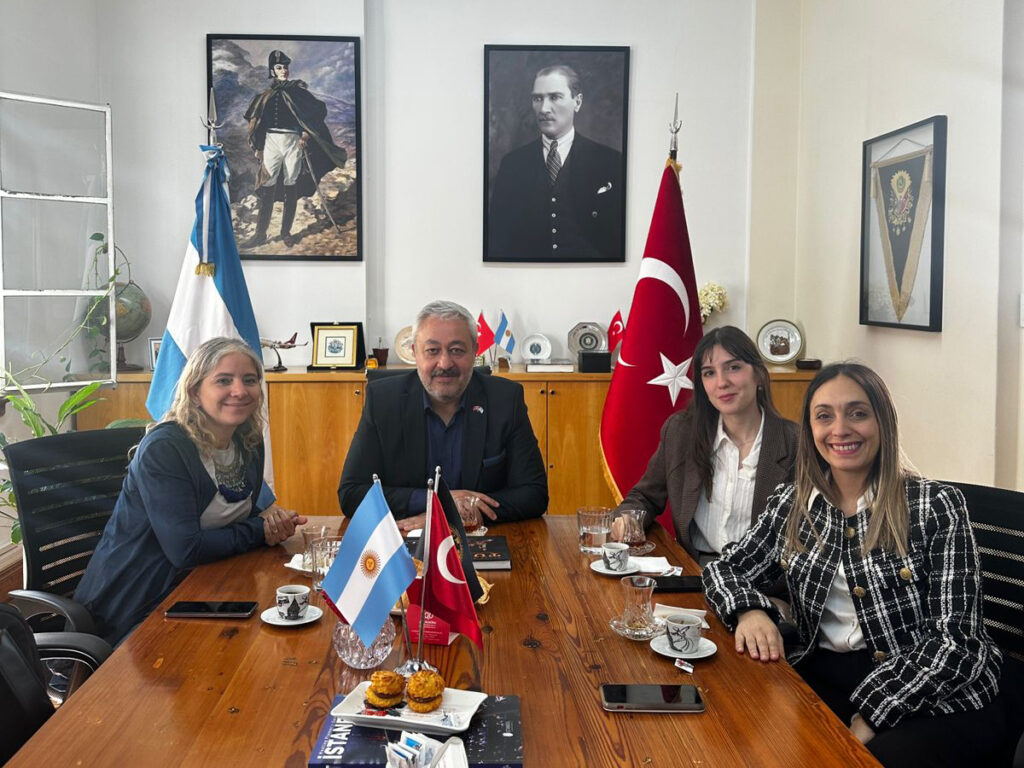
Since the early 2000s, Turkey has implemented a more active foreign policy and positioned itself as an emerging global power. This strategy has included an exponential expansion of its presence in Latin America. The bilateral relationship with Argentina already includes instances of economic cooperation beyond the defense sector. In this regard, the Argentine-Turkish Chamber of Commerce has been actively promoting these economic and business ties, articulating initiatives that can transform this complementarity into concrete projects in investment, technology transfer, and bilateral trade.
There are various examples that highlight the strategic nature of the Argentina-Turkey relationship and the aim of strengthening commercial, technological, and cultural ties. Among them is the joint production between Turkish companies and Invap of the ARSAT (SG-1) satellite.
Within this broader framework, defense cooperation is particularly relevant given Argentina’s need to modernize its Armed Forces and the high technological standards and self-sufficiency achieved by Turkey’s defense industry, which offers a wide range of solutions in electronics, weaponry, naval, land, and air systems. Turkey’s increasing capacity to develop and export military equipment positions it as a key strategic ally for nations seeking to modernize their armed forces without relying solely on traditional powers.
Argentina’s recent purchase of 24 used F-16 fighter jets from Denmark, another NATO member, clearly indicates the Argentine government’s alignment with the NATO bloc. More specifically, in relation to Turkey, Argentina is currently evaluating a modernization project for its MEKO 360 destroyers proposed by a Turkish company. Similarly, Turkey’s defense industry could offer solutions for upgrading armored vehicles, unmanned aerial vehicles (UAVs), helicopters, and even hyperbaric chambers for medical treatments and decompression chambers. Argentina’s existing industry could greatly benefit from technology transfer and the creation of joint ventures.
Argentina’s pursuit of a global partnership with NATO and the strengthening of its bilateral ties with a key NATO ally like Turkey are interconnected moves. In this context, Turkey emerges as an indispensable strategic partner. For Turkey, Argentina represents a potential strategic partner and a gateway to Latin America, while Turkey can serve as Argentina’s entry point to Europe and the Middle East.
Technological, industrial, and commercial cooperation between the two countries represents a “win-win” scenario, making it essential to continue building bridges between them. In this regard, the role of institutions such as the Argentine-Turkish Chamber of Commerce becomes particularly relevant in channeling this process and creating spaces for institutional cooperation that enhance economic relations and cultural exchange between both nations.
By Özgür Yücel Demir, President of the Argentine-Turkish Chamber of Commerce.